Indian forest and water conservation
Real people. Real sacrifice. Real change.

India's Green Champions& World Lessons

Ordinary Indians who gave their lives to protect forests, rivers, and water — and the cities around the world proving that when communities act together, water always wins.

🏆
19
Stories of change
40+ yrs
Average commitment
👨‍👩‍👧
25M+
Lives impacted
🌍
6
Nations showing the way
Featured Story
Jadav Payeng - Forest Man of India
🌿 Forest Padma Shri 2015
JP

Jadav Payeng

Forest Man of India

Majuli Island, Assam·1979 - Present
The forest is my life. I will keep planting trees until I die.

At 16, Jadav found dead snakes baking on a barren sandbar after a flood — there were no trees to shelter under. With no money and no support, he started planting alone. Every single day for over 40 years, he came to his sandbar and planted. Nobody asked him to. Nobody paid him. Today the Molai Forest covers 1,360 acres — larger than New York's Central Park — and shelters tigers, rhinoceroses, elephants, and over 100 species of birds. He still lives inside it.

1,360
Acres of forest created
40+
Years of daily work
100+
Species now living there
Share:𝕏 PostFacebookLinkedIn
More Champions
Rajendra Singh - Waterman of India
💧 Water
RS
Rajendra Singh
Waterman of India
Alwar, Rajasthan·1985 - Present
Water is life. Whoever protects water protects life itself.

Rajendra came to rural Rajasthan to teach and found villages dying of thirst. Instead of a school, he built a johad — a traditional earthen check dam — with the community. Water returned. Then he did it again, and again. Over decades he mobilised thousands of villagers to build over 8,600 johads across the Aravalli hills. Five rivers that had run dry for years began to flow again. More than 1,000 villages now have water year-round.

5
Dead rivers revived
1,000+
Villages with water access
8,600+
Johads (check dams) built
Stockholm Water Prize 2015
Share:𝕏 PostFacebookLinkedIn
Afroz Shah - Beach Warrior of Mumbai
🌊 Ocean
AS
Afroz Shah
Beach Warrior of Mumbai
Versova Beach, Maharashtra·2015 - Present
The ocean does not need our permission to be clean. It just needs us to stop.

When lawyer Afroz Shah moved to a flat near Versova beach, he found it buried under years of garbage. He started cleaning alone one Saturday morning. A neighbour joined. Then ten people. Then hundreds. For 85 consecutive weekends — rain or shine — volunteers showed up. Over 12 million kg of trash was removed. The result was extraordinary: olive ridley sea turtles, absent for two decades, crawled onto Versova Beach and laid eggs again.

12M kg
Plastic and waste removed
85
Consecutive weeks of cleanup
500+
Volunteers at peak weeks
UN Champion of Earth 2016
Share:𝕏 PostFacebookLinkedIn
Tulsi Gowda - Encyclopedia of the Forest
🌿 Forest
TG
Tulsi Gowda
Encyclopedia of the Forest
Ankola, Karnataka·1960 - Present
I do not plant for fame. My heart tells me to do it, so I do.

Born into the Halakki tribal community, Tulsi never attended a single day of school. Yet forest officials say she knows more about plants and trees than any textbook — she can identify every species, its medicinal use, and its role in the ecosystem just by looking at it. For over 60 years she has worked at the government forest nursery, nurturing over 30,000 trees. When the President of India awarded her the Padma Shri, she walked up barefoot to accept it.

30,000+
Trees planted and nurtured
60+
Years of forest work
0
Days of schooling — self-taught
Padma Shri 2021
Share:𝕏 PostFacebookLinkedIn
Chhewang Norphel - Ice Man of India
💧 Water
CN
Chhewang Norphel
Ice Man of India
Leh, Ladakh·1987 - Present
I just moved water from where it was useless to where it was needed most.

Ladakhi farmers had a painful problem: their crops needed water in spring, but the natural glaciers only melt in summer. Retired civil engineer Chhewang Norphel had a simple idea — divert river water into shaded, flat channels in winter, let it freeze into a glacier, and let it melt slowly when farmers needed it. He built 15 artificial glaciers across Ladakh using this method. Over 10,000 farmers now have water at the right time of year.

15
Artificial glaciers built
10,000+
Farmers with spring water
26
Ladakhi villages served
Padma Shri 2015
Share:𝕏 PostFacebookLinkedIn
Ramveer Tomar - Pond Man of India
💧 Water
RT
Ramveer Tomar
Pond Man of India
Greater Noida, Uttar Pradesh·2014 - Present
Every pond I clean is a water bank I open for the next generation.

School teacher Ramveer Tomar watched the ponds of his village — the lifeblood of local farmers and groundwater — slowly choke with garbage and encroachments. After school, on weekends, he began cleaning them. He involved children, then parents, then whole communities. One by one, ponds that were completely dead came back to life. He has now revived over 35 ponds across UP, restoring groundwater and clean water to tens of thousands of families.

35+
Dead ponds revived
50,000+
People with better water
10
Years of weekend work
Share:𝕏 PostFacebookLinkedIn
Saalumarada Thimmakka - Mother of 8,000 Trees
🌿 Forest
ST
Saalumarada Thimmakka
Mother of 8,000 Trees
Hulikal Village, Karnataka·1950s - Present
Trees are my children. They give shade to everyone without asking anything in return.

Thimmakka and her husband could not have children. So they planted trees instead — and raised them as their own. Starting with just 10 banyan saplings along a dusty highway, they carried water by hand to nurse each one. Over decades they lined 4.5 km of road with 385 banyan trees, then planted thousands more across Karnataka. Now in her nineties, she still visits her trees. "Saalumarada" in Kannada means "trees in a row" — a name her community gave her.

8,000+
Trees planted in lifetime
4.5 km
Tree-lined highway created
70+
Years of tree care
Padma Shri 2019
Share:𝕏 PostFacebookLinkedIn
Prafulla Samantara - Guardian of Niyamgiri
🏔 Land
PS
Prafulla Samantara
Guardian of Niyamgiri
Niyamgiri Hills, Odisha·1990 - Present
Nature and communities are not obstacles to development — they are development itself.

When a global mining company sought to extract bauxite from Niyamgiri — a mountain sacred to the Dongria Kondh tribe and the source of two rivers — Prafulla Samantara chose to fight. For over 25 years he organised the tribal community, fought legal battles through every court in India, and brought the case to the Supreme Court. The tribal communities voted unanimously in gram sabhas to protect their mountain. The mine was stopped. The rivers still flow.

2
Rivers protected from destruction
8,000+
Tribal people protected
25+
Years of legal battles won
Goldman Environmental Prize 2017
Share:𝕏 PostFacebookLinkedIn
Sant Balbir Singh Seechewal - The Priest Who Cleaned a Sacred River
💧 Water
SS
Sant Balbir Singh Seechewal
The Priest Who Cleaned a Sacred River
Sultanpur Lodhi, Punjab·2000 - Present
Guru Nanak sat on these banks and found enlightenment. How can we let it be a sewer? The river will flow clean again — I promise this.

The Kali Bein is no ordinary stream. Guru Nanak Dev Ji — founder of Sikhism — meditated on its banks for three years. But by 2000, all 160 km of it had become an open sewer carrying raw sewage and industrial waste. Sant Seechewal waded in personally, knee-deep in filth, and began cleaning. Without government money, without machines, armed only with faith and sheer determination, he rallied thousands of volunteers. His community raised donations to build 11 sewage treatment plants on the banks. He lobbied successfully to have industrial discharge banned. Fifteen lakh trees were planted on the riparian belt. Today fish have returned to the Kali Bein for the first time in 50 years — and pilgrims walk its banks again. His model, called the "Seechewal Model," is now being studied for replication on the Sutlej and Yamuna.

160 km
Sacred river fully cleaned
11
STPs built with community funds
15L
Trees planted on the banks
Padma Shri 2017
Share:𝕏 PostFacebookLinkedIn
Kalpana Ramesh - The Rooftop Rain Lady of Hyderabad
💧 Water
KR
Kalpana Ramesh
The Rooftop Rain Lady of Hyderabad
Hyderabad, Telangana·2007 - Present
Your roof is a watershed. Every drop that falls on it belongs in the ground below you — not in the storm drain.

When Hyderabad's borewells crashed during the 2002 drought, Kalpana Ramesh installed a rainwater harvesting system on her own rooftop and found it replenished her groundwater so completely that her borewells never ran dry again — even as her neighbours' ran empty. That single result became her life's mission. She founded The Rainwater Project, going door to door, school to school, office to office across Hyderabad, demonstrating RWH installations and training residents. She consulted the GHMC to make RWH mandatory in all new construction above 300 sqm. Her NGO has now installed systems in over 1,500 buildings, trained more than 10,000 residents, and collectively recharged over 100 million litres of groundwater per year. In a city built on hard granite rock with almost no natural aquifer, she is rebuilding the water table from the top down.

1,500+
Buildings with RWH installed
10,000+
Hyderabad residents trained
100M L
Groundwater recharged per year
Share:𝕏 PostFacebookLinkedIn
Vikrant Tongad - Delhi's Wetland Warrior
💧 Water
VT
Vikrant Tongad
Delhi's Wetland Warrior
Delhi / NCR, Delhi·2012 - Present
Delhi's wetlands are invisible to most people. My job is to make the courts see them before the builders do.

In a city where wetlands are routinely bulldozed for housing projects before anyone even knows they exist, environment lawyer and activist Vikrant Tongad chose to fight using the only tool that could outpace a bulldozer — the courts. He spent years personally documenting illegal construction at over 800 water bodies across NCR, photographing encroachments, collecting evidence, and filing PILs. When his case reached the Supreme Court, it directed all states to identify and notify wetlands within six months. Sanjay Lake and several other Delhi wetlands were formally gazzetted as protected areas. His decade of grinding legal work has stopped construction on wetlands that would otherwise have vanished under concrete — along with the migratory birds, amphibians and groundwater recharge they silently provided.

800+
Wetland encroachments documented
5+
Wetlands legally protected via PIL
500+ ac
Urban wetland area saved from concrete
Share:𝕏 PostFacebookLinkedIn
Sonam Wangchuk - Inventor of the Ice Stupa
💧 Water
SW
Sonam Wangchuk
Inventor of the Ice Stupa
Phyang, Leh, Ladakh·2013 - Present
Nature already has the answer. We just have to look carefully enough to see it.

Ladakh's farmers lose crops every spring — not because there is no water, but because it arrives too late. Natural glaciers melt in June; crops need water in March and April. Engineer and educator Sonam Wangchuk cracked a solution hiding in Buddhist tradition: the stupa shape. He realised that a conical ice tower has far less surface area per volume than a flat sheet, so it melts slowly. His team built the first Ice Stupa in 2013 — piping river water through buried pipes in winter, letting it freeze around a central pole into a 30-metre cone of ice. It melts precisely into spring. The first stupa irrigated over 10 hectares and gave water to three villages. Wangchuk's model is now being replicated across Ladakh, Himachal Pradesh, and parts of Nepal and Pakistan. His ice stupas cost a fraction of conventional glaciers and can be built anywhere.

30 m
Height of first Ice Stupa built
10+
Hectares irrigated each spring
20+
Ice stupas now across Ladakh
Rolex Award for Enterprise 2016
Share:𝕏 PostFacebookLinkedIn
Chandi Prasad Bhatt - Father of the Chipko Movement
🌿 Forest
CB
Chandi Prasad Bhatt
Father of the Chipko Movement
Gopeshwar, Chamoli, Uttarakhand·1973 - Present
What are the forests for? Soil, water, and pure air. Soil, water, and pure air are the basis of our life.

In March 1973, commercial loggers arrived in Mandal forest near Gopeshwar with permission to fell hundreds of trees. The women of the village, led by Gaura Devi and organised by Chandi Prasad Bhatt, did something that astonished everyone — they walked into the forest and hugged the trees, daring the axes to fall on them instead. The loggers left. Chipko — meaning "to hug" — spread across the Himalayas. The movement was not simply about trees. The villagers understood, instinctively, what science would later confirm: felling the Himalayan forests destroyed the springs and streams that millions depended upon. The roots held the soil; the canopy fed the clouds. When the trees went, the water went. Bhatt spent decades documenting this connection, building local organisations, and lobbying successfully for a 15-year logging ban in the Himalayas. The ban came into force in 1980 and transformed environmental policy in India.

15-yr
Logging ban won for Himalayas (1980)
1,000+
Villages that joined the movement
50+ yrs
Of Himalayan forest protection
Ramon Magsaysay Award 1982 · Padma Bhushan 2005
Share:𝕏 PostFacebookLinkedIn
Anna Hazare - Village of the Future: Ralegan Siddhi
💧 Water
AH
Anna Hazare
Village of the Future: Ralegan Siddhi
Ralegan Siddhi, Ahmednagar, Maharashtra·1975 - Present
Development doesn't come from Delhi. It comes from the village, from the people, from the ground up.

In 1975, Ralegan Siddhi was a drought-ravaged village in Maharashtra with chronic water shortage, failed crops, rampant alcoholism, and families leaving. Anna Hazare, then a retired army driver, returned and decided it would not stay that way. He began with something simple: he stopped the liquor trade, which was draining household incomes, and redirected that energy into a massive community watershed programme. Villagers built contour trenches, nala bunds, percolation tanks, and check dams — all by collective voluntary labour. They planted trees on every slope to hold the soil. They adopted crop rotation to reduce water demand. Within a decade the water table had risen dramatically. Seasonal streams now flowed year-round. Farmers moved from one crop to two, then three. The village stopped receiving drought relief. By the 1990s, Ralegan Siddhi was a national model — governments, NGOs, and communities from across India came to study it. Hazare's method has since been replicated in over 80 villages across Maharashtra under the Hind Swaraj Trust.

25 ft
Rise in groundwater level over 10 years
1,200
Families lifted from drought poverty
80+
Villages that replicated the model
Padma Bhushan 1992
Share:𝕏 PostFacebookLinkedIn
Seoul, South Korea - Demolished a Highway to Bring Back the River
🌐 World Lesson
SE
Seoul, South Korea
Demolished a Highway to Bring Back the River
Cheonggyecheon Stream, South Korea·2003 - 2005
We did not build the Cheonggyecheon. We simply got out of the way and let it come back.

For 45 years, the Cheonggyecheon — a stream running 6 km through the heart of Seoul — lay buried under a concrete elevated highway and a 16-lane expressway. In 2003, then-mayor Lee Myung-bak made the audacious decision to tear both down and restore the stream. Engineers, economists, and urban planners warned of catastrophic gridlock and economic collapse. The project went ahead. What happened next astonished the world: temperatures along the restored corridor dropped 3.6°C compared to surrounding streets. More than 639 species of fish, birds, insects, and plants colonised the previously dead concrete channel. Property values within 1 km rose by over 50%. Pedestrian footfall tripled. Today the Cheonggyecheon is Seoul's most popular public space and the most studied urban water restoration project on Earth. Cities from Los Angeles to Bengaluru are using it to justify removing their own concrete rivers.

5.8 km
Elevated highway torn down
639
Species returned to the stream
3.6°C
Cooler than surrounding streets
UN-Habitat Scroll of Honour 2006
Share:𝕏 PostFacebookLinkedIn
Singapore - No Rivers, No Problem: World's Best Water City
🌐 World Lesson
SG
Singapore
No Rivers, No Problem: World's Best Water City
Marina Barrage & NEWater, Singapore·1965 - Present
In Singapore, no drop of water is ever wasted. Every drop is used, cleaned, and used again.

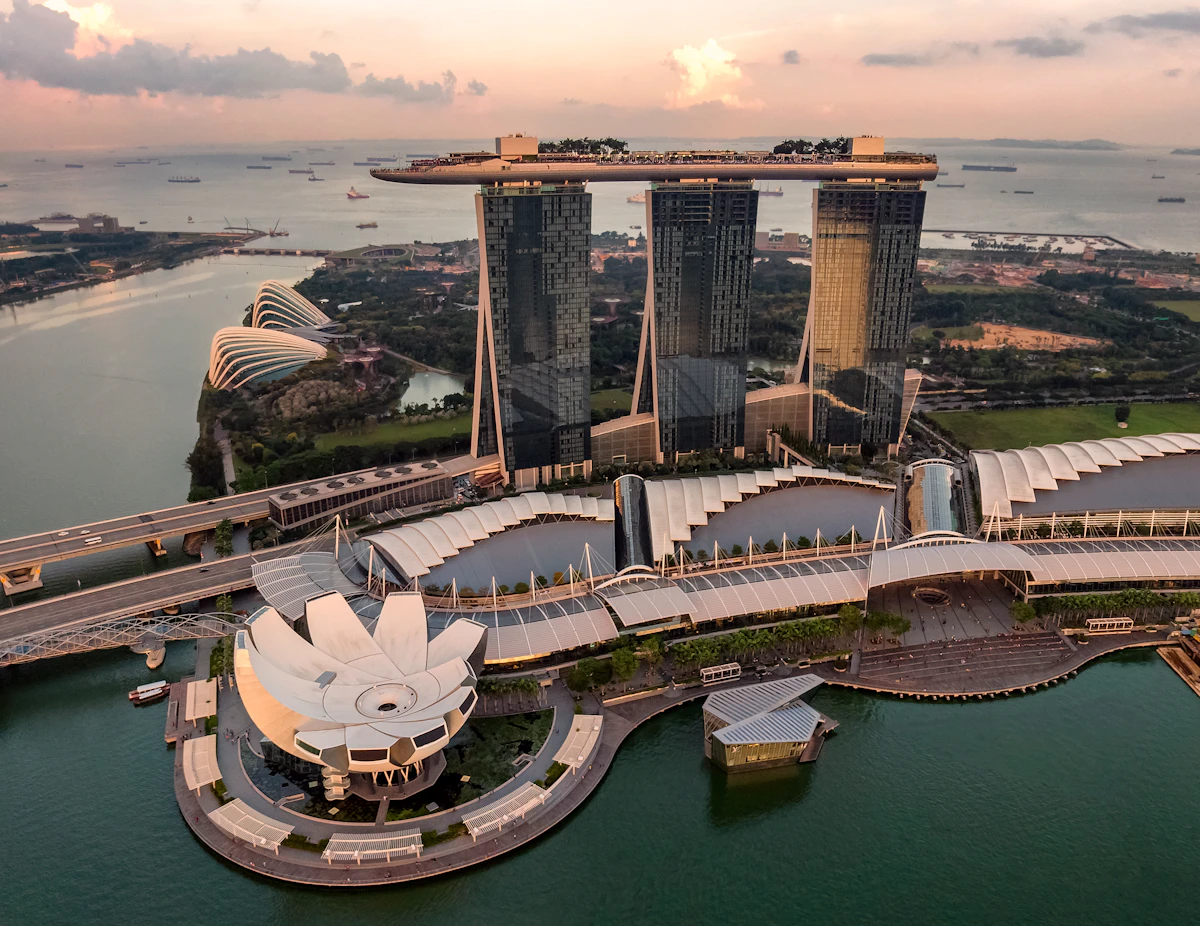
When Singapore became independent in 1965, it had no rivers, no groundwater, and imported nearly all its water from Malaysia. A water cut-off could collapse the city-state within days. The government decided to solve this problem permanently, not patch it. They built a Four National Taps strategy over 60 years: collected rainwater in 17 reservoirs covering two-thirds of the island's land area; built the Marina Barrage to turn a tidal estuary into a freshwater reservoir in the heart of the city; developed NEWater — high-grade reclaimed water treated to WHO drinking standards, used in semiconductor factories, sports stadiums, and mixed into the reservoir supply; and built desalination plants for drought insurance. Today Singapore meets 40% of its needs from NEWater and 30% from desalination. By 2060 it will need zero water imports — a city of 6 million on 733 sq km with no natural freshwater rivers, completely water-independent. Every Indian metro is studying this blueprint.

17
Reservoirs covering 2/3 of the island
40%
Water needs met by NEWater (recycled)
2060
Year it will need zero water imports
Stockholm Water Prize (PUB Singapore) 2007
Share:𝕏 PostFacebookLinkedIn
Cape Town, South Africa - The City That Refused Day Zero
🌐 World Lesson
CT
Cape Town, South Africa
The City That Refused Day Zero
Cape Town, South Africa·2017 - 2018
Day Zero was not a failure. It was the alarm that saved us. We just had to be brave enough to ring it loudly.

In early 2018, Cape Town's six reservoirs had dropped to 13.5% usable capacity. Engineers set a date: Day Zero — the day the city would turn off all municipal taps and residents would queue at 200 distribution points with 25 litres per day. It would have been the first time in modern history a major global city ran completely out of water. Then something unexpected happened. Four million residents decided, collectively, that Day Zero would not come. The city set a 50-litre-per-person-per-day target — the international emergency survival threshold. People installed greywater systems, checked their neighbours' usage, reported leaks, and collectively cut usage by 58%. Day Zero was postponed, then cancelled. Cape Town is now the world's definitive proof that when citizens are told the truth about a water crisis and given clear targets, they will achieve the extraordinary.

50 L/day
Per-person limit citizens achieved
58%
Drop in city water use in 6 months
0
Times Day Zero actually arrived
C40 Cities Adaptation Award 2018
Share:𝕏 PostFacebookLinkedIn
Israel - How a Desert Nation Invented Drip Irrigation
🌐 World Lesson
IL
Israel
How a Desert Nation Invented Drip Irrigation
Negev Desert & Kibbutz Hatzerim, Israel·1965 - Present
We made the desert bloom — not by finding more water, but by wasting less of it.

In 1965, Israeli engineer Simcha Blass noticed something curious: a large tree growing in the desert beside a leaking buried pipe was far healthier than every tree around it. He realised that slow, direct-to-root water delivery was drastically more efficient than flood or sprinkler irrigation. He partnered with Kibbutz Hatzerim to commercialise the idea into what became Netafim — the world's first drip irrigation company. Israel is a country where 60% of the land is desert and average annual rainfall is just 450 mm. By adopting drip irrigation nationwide, Israeli farmers reduced water use per kilogram of produce by over 50% while doubling and tripling yields. Today Netafim operates in 110 countries and drip-irrigates over 10 million hectares worldwide — including millions of hectares in India's Maharashtra and Karnataka. Israel recycles 90% of its wastewater for agriculture, the highest rate in the world. A nation with almost no water became the world's most water-efficient food producer.

50%+
Less water per kg of food produced
110
Countries using Netafim drip tech
90%
Wastewater recycled for agriculture
Share:𝕏 PostFacebookLinkedIn
Netherlands - Living With Water: The Delta Works
🌐 World Lesson
NL
Netherlands
Living With Water: The Delta Works
Rhine-Maas-Scheldt Delta, Netherlands·1953 - Present
God made the world, but the Dutch made Holland. Now we must learn to share it with water, not fight it.

On the night of 31 January 1953, a catastrophic North Sea storm surge broke through the Dutch sea dikes, flooding 1,600 km and killing 1,836 people. Within days the Netherlands committed to one of the most ambitious engineering projects in human history: the Delta Works. For 45 years they built a series of dams, sluices, locks, dikes, and storm surge barriers across the delta of the Rhine, Maas, and Scheldt rivers. The Maeslantkering — two massive steel arms each the length of the Eiffel Tower — can close in two hours and holds back the North Sea in a storm. One-third of the Netherlands sits below sea level; the Delta Works protects 10 million people and 65% of the country's GDP. But the Dutch did not stop there. After the 1990s floods they adopted a radical new philosophy: Room for the River — deliberately giving land back to rivers, relocating farms and villages, and designing cities with water squares and green rooftops that absorb floods instead of fighting them. Rotterdam, half of which sits below sea level, now exports its water management expertise to Jakarta, Ho Chi Minh City, New York, and Mumbai.

10M
People protected from North Sea floods
65%
Of Dutch GDP protected by Delta Works
100+
Countries buying Dutch water expertise
ASCE Outstanding Civil Engineering Achievement 1999
Share:𝕏 PostFacebookLinkedIn

Explore topics

#WaterIntel#WaterConservation#IndiaWater#SaveWater#GreenChampions#ClimateAction#ForestHero#WaterWarrior#BeachCleanup#RainwaterHarvesting#Sustainability#IndiaEnvironment#JalShakti#WaterForAll#GreenIndia#EcoHero#WaterHarvesting#GroundwaterIndia#RiverRevival#PlantATree#SeechwalModel#DayZero#SingaporeWater#CheonggyecheonRevival

Their work continues — so does yours

From a Punjab priest cleaning a sacred river alone, to Cape Town's 4 million citizens holding back Day Zero — every water victory starts with one person refusing to give up. Check your city's water health. Share this with someone. Every litre you save is part of this story.

WATER INTEL — India Water Intelligence Platform